Can Foreigners Safely Own Villas in Phuket?
Phuket continues to attract foreign buyers seeking tropical luxury, lifestyle investment, and long-term value. However, one crucial question consistently arises:
Can foreigners legally own villas in Thailand—and what is the safest ownership structure?
The confusion usually centers around Freehold vs. Leasehold property ownership in Thailand, particularly for villas rather than condominiums. Misunderstanding these legal frameworks can lead to costly mistakes, insecure ownership, or limited resale potential.
This guide is written specifically for foreign buyers considering villa ownership in Phuket. We will break down:
- The legal differences between freehold and leasehold
- The "Hidden Safety" of owning the building separate from the land
- The reality of the "30+30+30" lease structure
- How to choose the safest option for long-term security
Whether you’re buying for lifestyle, retirement, or investment, this article will help you make a legally sound decision.
Understanding Property Ownership Laws in Thailand
Before comparing freehold and leasehold, it’s essential to understand Thailand’s legal foundation regarding foreign ownership.
Can Foreigners Own Land in Thailand?
In general, foreigners cannot directly own land in Thailand. This restriction applies regardless of whether the property is a luxury villa, a pool house, or a landed estate.
However, foreigners CAN legally own:
1. Condominium units (Freehold): Up to 49% of the building’s total saleable area.
2. Buildings & Structures: You can own the house itself, distinct from the land it sits on.
3.Leasehold Rights: You can register a long-term lease on the land (up to 30 years).
Option 1: What Is Freehold Ownership? (Chanote Title)
Definition of Freehold - Freehold ownership means full ownership registered at the Land Department, usually supported by a Chanote (Nor Sor 4 Jor) title—the strongest form of land ownership in Thailand. For Thai nationals, this includes the land, the building, and permanent inheritable rights.
Can Foreigners Own Freehold Villas?
Not directly in their own name. However, there is a common method used to achieve a form of freehold control:
The Thai Company Structure - Foreigners may set up a Thai Limited Company to hold the land. However, this method comes with strict legal requirements:
- Shareholding: Foreigners can hold up to 49% of shares (Thai nationals must hold 51%).
- Active Business: The company must be a legitimate, active business (generating revenue, filing taxes, holding shareholder meetings).
- Risk Warning: Using "Nominee" shareholders solely to circumvent land laws is illegal and is actively investigated by the Department of Business Development (DBD).
Expert Tip: If you choose the company route, ensure you have a professional legal team to manage annual audits and compliance to prove the company is an active entity.
Option 2: What Is Leasehold Ownership?
Leasehold Explained - Leasehold allows a foreigner to lease the land for a fixed period. The lease is registered directly on the back of the title deed at the Land Department.
- Legal Duration: 30 years (guaranteed by Thai Civil and Commercial Code).
- Security: Once registered, the lease is binding on the land, even if the land is sold to a new owner.
The Truth About "30+30+30" Leases
Many luxury developments in Phuket market villas with a "90-year lease" (30+30+30). It is crucial to understand the reality:
1. The First 30 Years: Guaranteed by law and registered on the title deed.
2. The Renewals (Next 60 Years): These are contractual promises between you and the developer. They are not automatic property rights registered in advance.
3. Safety Check: To make this safe, ensure the developer is reputable and the renewal clauses are drafted carefully to bind future landowners.
The Hybrid Solution: Leasehold Land + Freehold Building
This is often considered the safest structure for foreign villa buyers.
In this scenario:
1. You Lease the Land (30-year registered lease).
2. You Own the Building (Freehold) in your own name.
Why is this safer?
- Asset Security: You legally own the concrete structure (the villa). The landlord cannot easily evict you because you own the house sitting on their land.
- Depreciation: You can account for the building as an asset.
- Simplicity: No need to maintain a Thai company or file annual audits.
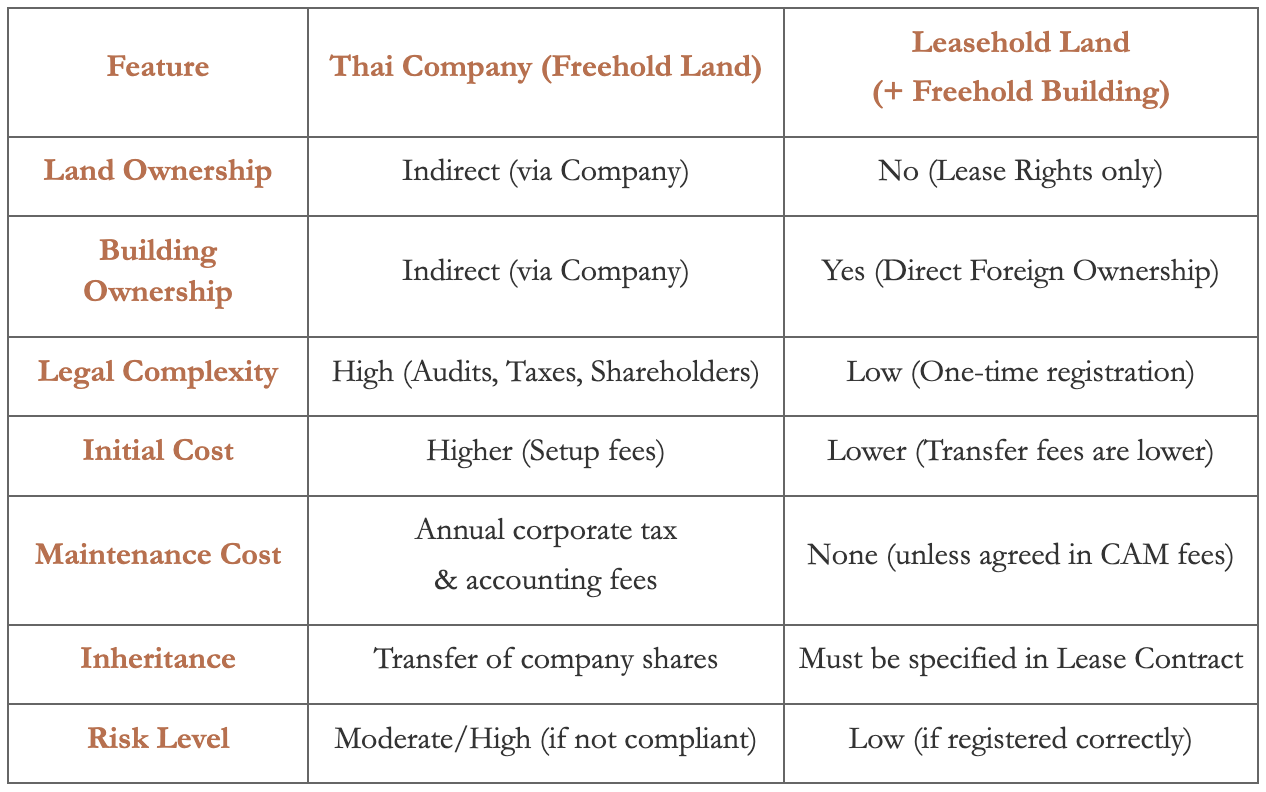
Freehold vs. Leasehold: Side-by-Side Comparison
Which Is Safer for You?
Choose "Company Freehold" If:
- You intend to run a genuine business (e.g., a rental villa business generating income).
- You have the budget for ongoing legal and accounting maintenance.
- You want to hold the property for generations (ignoring lease expirations).
Choose "Leasehold + Building Ownership" If:
- You want a hassle-free holiday home or retirement villa.
- You prefer legal simplicity and lower upfront costs.
- You want to avoid the risks associated with "nominee" shareholders.
- You plan to sell within 10-20 years (Leasehold is highly liquid in Phuket's expat market).
Step-by-Step Guide to Buying Safely
1. Due Diligence: Always check the land title (Chanote) and access rights (road access).
2. Choose the Structure: Decide between Company or Leasehold based on your lifestyle.
3. Separate the Building: If choosing leasehold, insist on a Sale and Purchase Agreement for the Structure separate from the Land Lease.
4. Register at Land Office: Ensure the lease is officially written on the title deed.
5. Tabien Baan: Apply for the "Blue Book" (or Yellow Book for foreigners) to prove your address and ownership of the building.
There is no single "best" ownership model for foreign villa buyers in Phuket—but there is a safest option for your specific needs.
For many buyers, the Leasehold Land + Freehold Building structure offers the perfect balance of security and simplicity without the legal grey areas of company ownership. However, if you are a serious investor, a compliant Thai Company may suit your portfolio better.
Always consult with an independent lawyer before signing any reservation agreement. Your dream villa in Phuket deserves a solid legal foundation.
Contact Us
For sales and villa information: Email: sales@pavaragroup.com
For legal-related enquiries, such as villa ownership, due diligence report:
Mr. Ittinant Suwanjutha, Partner, IAS Advisory Co.,Ltd.
Email: ittinant@ias-law.com Mobile: 0612387447